
Areas · the eastern shore
Pest control in Warners Bay
Warners Bay is the eastern shore's cafe town: an esplanade strip on the lake, a working town centre, and more units and townhouses than anywhere else in this cluster. That mix is why this is the page where we spell out shared-building work properly, because in a strata block a cockroach or rodent problem belongs to the building rather than to one kitchen.
What the work looks like here
A strata town in a ring of houses
Stand on the Warners Bay esplanade and the split is right in front of you: the cafe strip and the unit blocks behind it, then the detached-house hills rising away on every side. Roughly four in ten dwellings in Warners Bay are units or townhouses, a genuine town-centre strata segment, while the suburbs a few minutes up the hill, Macquarie Hills, Tingira Heights, Hillsborough, are almost entirely standalone houses. Same postcode belt, two very different pest jobs, and both inside a sub-eight-minute drive of this foreshore.
It is also a suburb that is still growing, not just ageing in place. New townhouse and unit stock keeps coming on around the town centre, so the strata work here is a live and expanding part of the round rather than a fixed set of old blocks. The established side is real too: most homes are still detached, plenty of them timber-floored, so the ordinary coastal termite work runs here the same as anywhere on this humid lakeside coast.
Warners Bay carries none of the bush-edge story you might expect of a lake suburb. The centre and the foreshore are established urban ground through and through, so the risks worth your attention are the everyday ones: termites on the coast's year-round band, insects through the warm months, and the shared-building patterns that come with living wall-to-wall.

The reason this is the strata page
In a shared building, the pest is the building's
A unit is not just a small house. Shared walls, shared waste areas, service risers and roof spaces all connect the tenancies, and a German cockroach or a rodent doesn't respect a lot line. Treat one unit on its own and you usually just move the traffic next door, which is why shared-building work is a different job with a different plan.
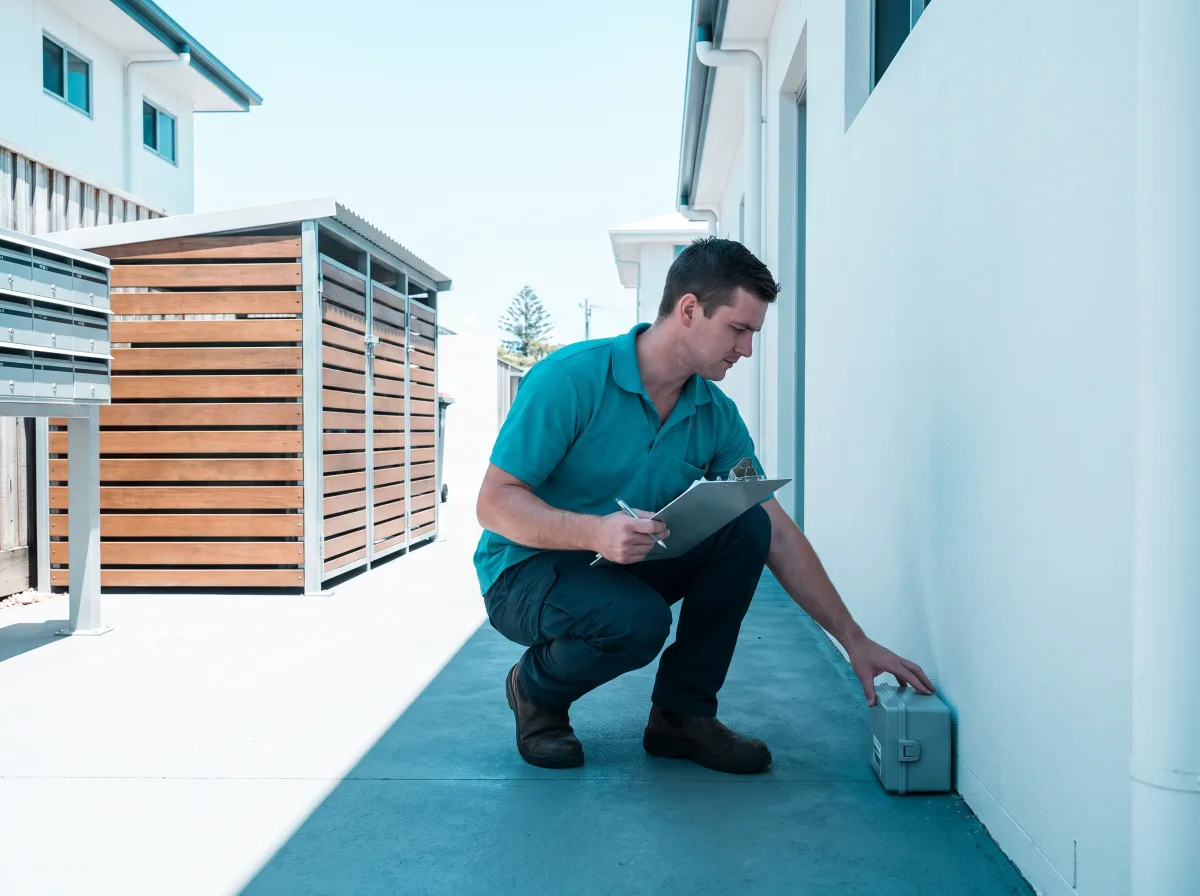
The pattern lives in the shared spaces, so that is where the work concentrates: the bin and waste enclosure, the service riser and meter cupboards, the subfloor or basement car park, the roof void that runs the length of the block, and the wall cavities the tenancies have in common. Read the building as one system and the harbourage and the runs make sense; read it one unit at a time and you chase the same roaches around the block for a year.
None of this needs alarm. It needs a plan the whole building runs to, so the treatment lands everywhere the pest actually is, and a written record each visit so the committee, the manager and the owners can all see what was done. That is the ordinary way a shared building stays on top of pests, and it is exactly what we set up here.
The common areas first: waste enclosure, risers, car park, roof void, shared cavities. The map of harbourage and runs is a building map, not a unit one.
Treatment placed everywhere the pattern reaches, on an interval that suits the building, so nothing gets pushed from a treated unit into an untreated one.
What was found, what was done, what to watch, written up for the strata records and ready for the committee or the AGM.
If your unit is the only one with a problem, we will say so and treat just yours. We only recommend a building-wide job when the building is genuinely where the pest lives.
Whoever is on the other end
Owners, agents and strata managers
Strata work has more people in it than a house call, and each of them needs a slightly different thing from us. Tell us which one you are in the enquiry and we will pitch the job the right way.
| If you are | What you are usually after | How we work with you |
|---|---|---|
| A unit owner-occupier | Something dealt with in your own unit, or a straight answer on whether the whole block needs a look. | We treat your unit and tell you honestly when the problem is bigger than your four walls, so you can raise it with the manager with something in writing behind you. |
| A landlord or managing agent | A tenant's report actioned, or documented work for the file at changeover. | Booked around the tenancy, done to a plan, and reported after every visit in a form the agency can drop straight into the file. |
| A strata manager or committee | A common-property program, or a building-wide roach or rodent job organised once and kept on schedule. | One plan for the whole building, one service interval, one report per visit for the records and the AGM. We are comfortable working in with your other trades and access arrangements. |
| A tenant | To get something seen to that you can't always commission yourself. | Tell us what you are seeing and where. We can point you, or your report, at the owner or manager who can approve the work. |
The through-line is the same one that runs the whole business: the report is the product. In a shared building it is also the thing that lets four different people agree on what is happening and what to do about it. The annual home round covers how the recurring relationship works for owners and agents alike.
The esplanade cafe strip
Food businesses on the foreshore
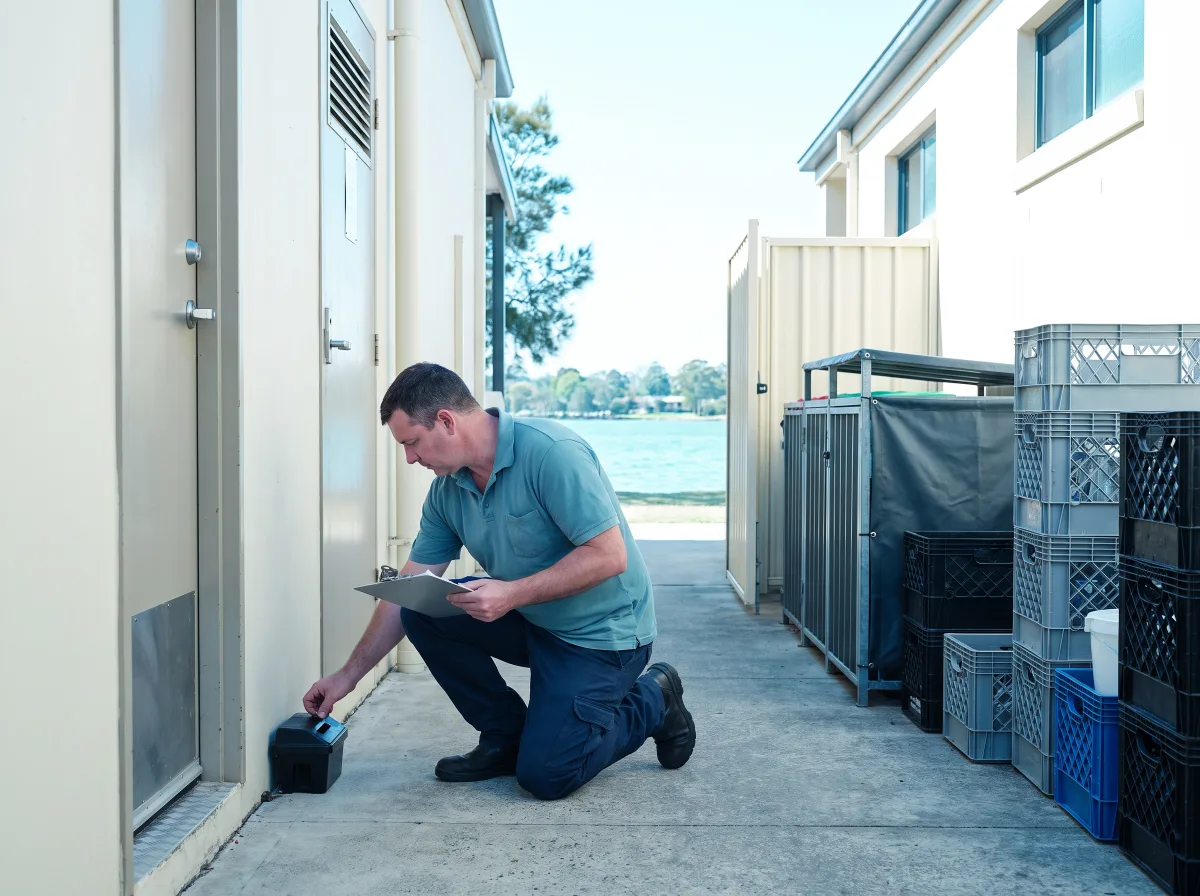
The Warners Bay esplanade is one of the eastern shore's busiest eating strips, and a lakeside cafe is a different pest job again. Kitchens, cool rooms, grease traps and shared rear service lanes are exactly the conditions cockroaches and rodents look for, and the strip's cafes often back onto one another, so the pressure belongs to the block of shopfronts as much as to any one kitchen, the same logic as the unit blocks up the road.
For a food business the file matters as much as the treatment. An audit wants a pest program running to schedule with the records behind it, so what the strip gets from us is exactly that: visits on a plan, each one written up, the folder ready whenever the auditor, the landlord or the franchisor wants it. No drama and no upselling, just the round kept and the paperwork current.
That is what our commercial work is built around: an interval matched to the premises, monitoring only where it earns its keep, and a visit report that stands up in the file.
The patch
Warners Bay and the eastern shore around it
Warners Bay sits at the middle of a tight eastern-shore patch, so the round runs short and often. These are real drive times from the town centre.
| Locality | Drive | Note |
|---|---|---|
| Eleebana | 4 min | lakeside established homes, near all detached |
| Cardiff | 5 min | established homes and the industrial fringe |
| Speers Point | 6 min | parkland streets at the lake's northern tip |
| Mount Hutton | 6 min | up the hill, the one neighbour that shares the strata character |
| Boolaroo | 8 min | the old smelter town, tight established stock |
| Charlestown | 8 min | the LGA's shopping heart, a few minutes north |
| Belmont | 11 min | the eastern shore's boating suburb |
Newcastle is about twenty minutes away, so Warners Bay is a genuine near-city suburb rather than a distant satellite. Toronto, on the far side of the lake, is a longer twenty-five minutes by road even though the map looks close, because the water sends the road the long way, and that is why we treat the western shore as its own separately-serviced patch.
On the register here
What Warners Bay books us for
-
01
The annual round, houses and units alike
General pest treatment kept on a rhythm: cockroaches and ants ahead of summer, rodents as autumn closes in, and the shared-building work that a unit block or townhouse row needs done as one plan.
the service → -
02
Commercial premises
The esplanade cafes, the food retail and the offices behind the strip: service on a schedule, written up every visit so the audit file stays current.
the service → -
03
Cockroaches, treated at the harbourage
The classic shared-building and food-strip pest: gel bait worked into where they actually live and breed, not a bench spray that scatters them.
the service → -
04
Termite inspections for the detached homes
Most of Warners Bay is still houses, plenty on timber floors, so the yearly inspection runs here the same as anywhere on this coast.
the service →
Asked in Warners Bay
Local questions
We're one unit in a block. Does the whole building need treating?
Sometimes yes, sometimes no, and we will tell you honestly which. If the problem really is just your unit, we treat your unit. If it is a German cockroach or a rodent pattern moving through the shared walls and waste areas, treating one unit alone usually just pushes it next door, and the building is better done as one plan. Either way you get it in writing, which helps if you need to raise it with the strata manager.
Who organises pest control in a strata building, the owner or the manager?
For common property and building-wide jobs it is normally the strata manager or the committee; inside your own unit it can be you. That grey area is exactly why the report matters. Tell us in the enquiry whether you are an owner, an agent or the manager, and we will set the job up so the right person can approve and record it.
We run a cafe on the esplanade. What does a pest program actually involve?
An interval that fits the kitchen's pace, monitoring where it makes sense, and a written record of every visit so the food-safety file stays audit-ready. Mention the food business in the enquiry, with a rough sense of how busy the kitchen runs, and the plan gets built around your trade. The commercial page lays out the whole shape of it.
Our block is only a few years old. Do new units get pests too?
They do. New construction is tighter, which helps, but German cockroaches travel in with deliveries, cartons and appliances, and once they are in a shared building they spread through the same walls and risers an older block has. Newer stock is genuinely a live part of the work here, not just the old blocks, so it is worth getting a plan in early rather than after the first bad summer.
Do you still do termite inspections here, or is it all unit work?
Both. The strata work is what makes Warners Bay stand out, but most homes in the suburb are still detached, and plenty are timber-floored on this humid coast, so the yearly termite inspection runs here exactly as it does everywhere else in the LGA. If it is a house, it is on the year-round termite band; the planner will pin your rhythm down.
Sources worth your time
- NSW EPA: pesticide and pest management licensing. Pest management is licensed trade work in NSW, and termite work carries its own endorsement. This is the regulator that administers it.
- NSW Food Authority. The food-safety scheme retail and hospitality businesses work under; a documented pest program is part of what a food-safety audit expects, which is the paperwork the esplanade's cafes are keeping.