
Services · 06 · per-pest
Spider control in Lake Macquarie
Most spider work here is the everyday kind: webbing spiders in the eaves and verandas, redbacks in the sheds and outdoor settings. We treat those sensibly, district-wide. And because the Newcastle funnel-web's whole known range takes in the LGA's north, this page also gives you the straight, unalarmed version of what that means, and what to do if anyone's ever bitten.
The everyday spiders
Webbing spiders, and the treatment that actually holds
The ones you notice first are the web-builders: black house spiders in the window frames, orb weavers strung across the path overnight, the daddy long-legs in the corner of every ceiling. Harmless, mostly, and relentless on a humid coast.
A one-off knockdown of the webs you can see doesn't last, because the spiders come back to the same sheltered lines: under the eaves, along the fascia, around the weep holes, in the window reveals and the veranda beams. The treatment that holds works those lines directly.
In practice that means brushing down the existing webbing first, then laying a treated band where spiders travel and rest, a perimeter application around the base of the house and up into the eaves and voids where the web-builders harbour. It's the same standing perimeter work that keeps ants and cockroaches down, which is why spiders usually ride along with the annual home round rather than needing a separate visit.
The method is described plainly on purpose: a treated zone, applied by a licensed technician, that spiders cross as they move. No brand names on this page, and no blanket "pet-safe" promise, because the honest answer to "is it safe around the kids and the dog?" depends on the product and how it's applied, and that's a conversation we have at the booking, not a slogan.
Pricing follows the same shape as the rest of the general work: a spider-and-web treatment is charged per treatment, or it's simply part of the annual home program. Either way it's confirmed with you before we book, never a surprise on the day. The annual home round is where it usually gets folded in.
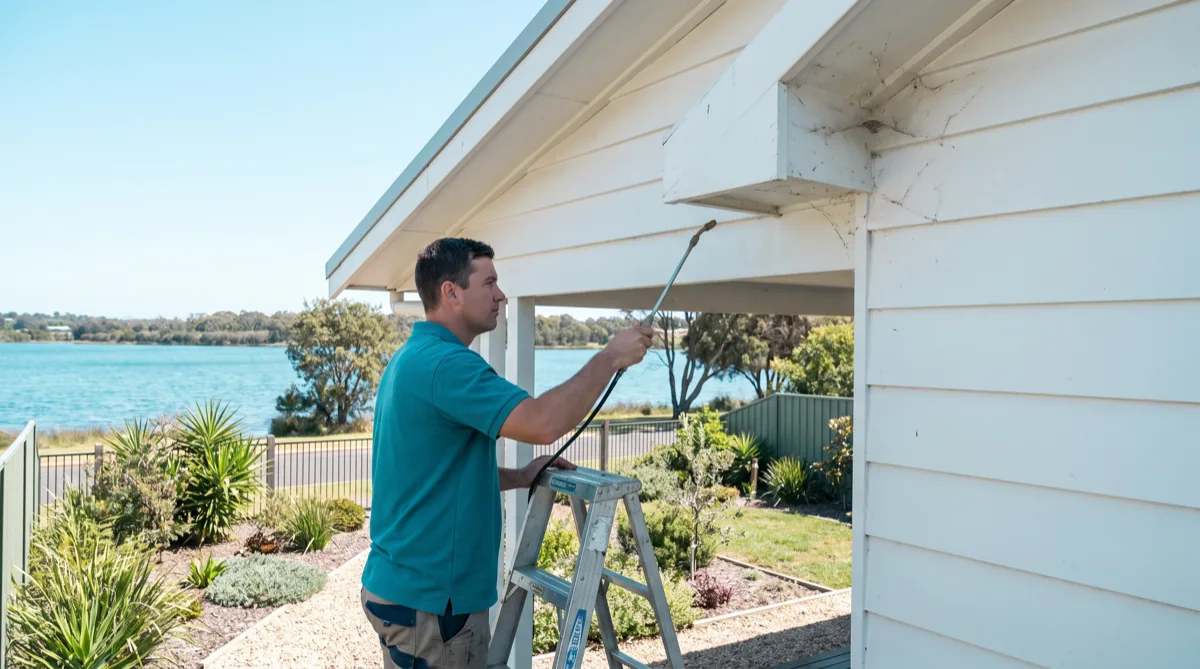
How a spider treatment runs
Four steps, done in order
Nothing mysterious about it. The order is what makes it stick, and it's the same whether we're there for webbing spiders or clearing redback harbourage.
-
Look and identify first
A walk around inside and out: eaves, weep holes, window frames, fences, sheds, the outdoor settings and the meter box. Identifying what's actually there decides the treatment, and it's the moment a redback nest gets found before anyone's hand does.
-
Knock down the webbing and nests
Existing webs and egg sacs get brushed out first, so the treatment reaches the surfaces spiders return to rather than sitting on top of old silk. Redback nests in the sheltered spots are cleared out as we go.
-
Treat the lines they travel
A treated band around the perimeter, up into the eaves and voids, and into the dry harbourage where redbacks shelter. Applied to where spiders move and rest, not sprayed at random across a wall.
-
Point out the conducive conditions
Then the free part: what's inviting them back. Outdoor lighting that pulls in the insects spiders eat, stacked timber and clutter against the walls, garden growth touching the house. Fixing those does more than any spray.
The venomous everyday one
Redbacks live where you least look
The redback is genuinely everywhere in the district, and it's the venomous spider you're most likely to actually meet, far more so than any funnel-web. It doesn't build a web across the path; it hides.
Redbacks like dry, sheltered, undisturbed spots close to the ground: under the outdoor table and chairs, in the corners of the shed and garage, inside the meter box and the letterbox, under the pot rims and the rainwater tank, in the folds of a rolled-up trampoline net or the frame of the kids' play equipment. The classic bite happens when a hand or a bare foot goes somewhere it hasn't looked.
Our part is to find and clear those harbourage spots and lay treatment through them. Your part is the ongoing half: keep the sheltered corners tidy and checked, wear gloves reaching under outdoor furniture, and knock out anything gathering in the play equipment before the kids do.
A redback bite is medically significant and worth taking seriously, but with modern care it's rarely a disaster, which is exactly why the calm version below matters more than the scary one. The Australian Museum's redback spider profile is the plain-facts source.
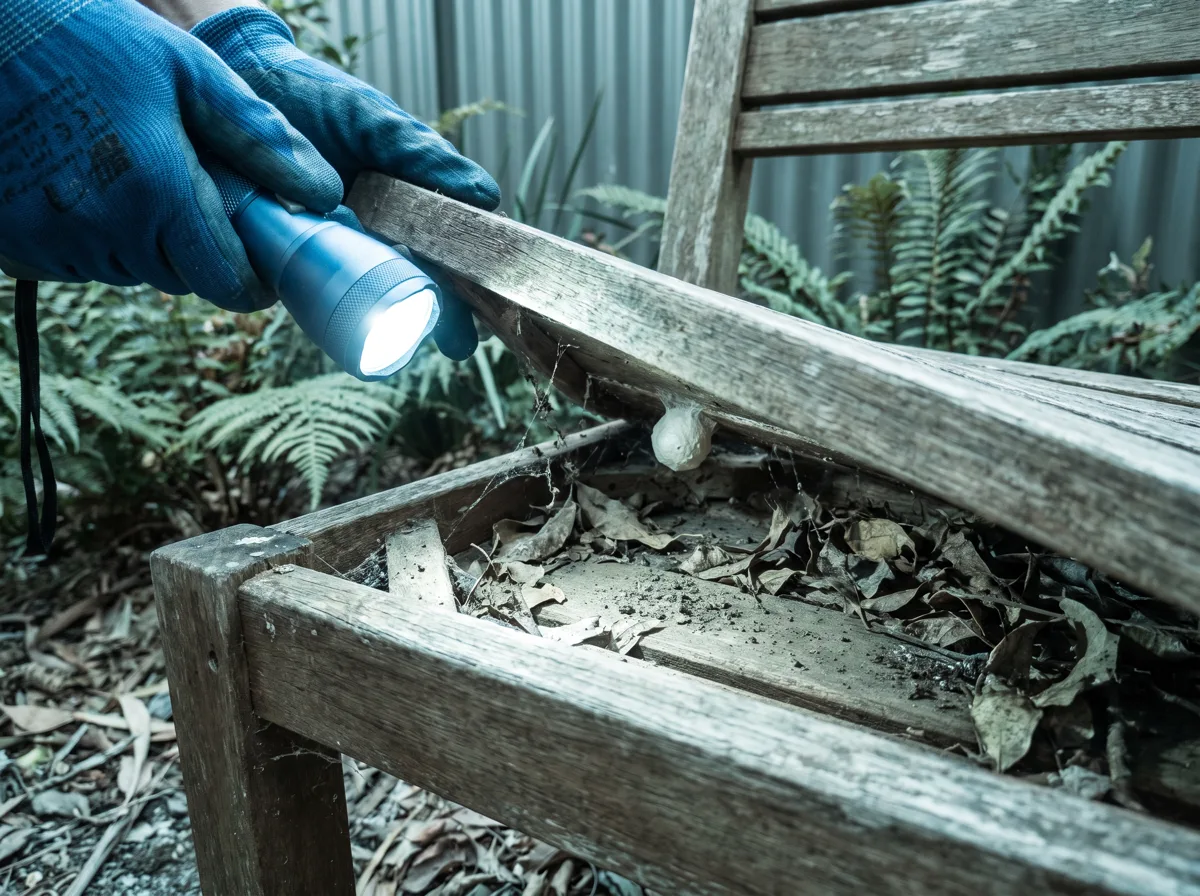
Straight talk, no scare
The Newcastle funnel-web, honestly
This is the one that gets sensationalised, so here's the measured version. Lake Macquarie's north sits inside the one patch of Earth where the Newcastle funnel-web is found. That's a real fact worth knowing calmly, not a reason to lie awake.
The species behind the headlines is Atrax christenseni, formally described as its own kind of funnel-web, distinct from the Sydney one. The Australian Museum records every sighting of it so far as falling within roughly a 25 kilometre radius of Newcastle, which reaches down over the northern edge of this LGA. Charlestown, Cardiff and Speers Point sit most squarely inside that band; the western and southern suburbs, Toronto and Morisset among them, sit beyond the range mapped to date.
It's a bigger spider than its Sydney cousin, with a leg span reaching around ten centimetres, and its venom is one that can be fatal without antivenom. The honest other half of that sentence matters just as much: not a single death has been recorded from any funnel-web bite in the decades since the antivenom arrived. The males go walkabout after rain in search of a mate, which is when they turn up in yards, pool filters and sheds, and it's a real bite reported at Lake Macquarie itself that put this on the local radar.
Here's the line we won't cross: nobody honest can tell you your particular house has funnel-webs, and we won't pretend to. A known range describes a district, never an address. What we can do is clear the damp, sheltered ground-level harbourage sensibly on the northern rounds, and make sure the one thing that actually saves lives, knowing the first aid, is on this page. The facts here are drawn from the Australian Museum's Newcastle funnel-web profile.
The part actually worth memorising
If someone is bitten
The two dangerous spiders here need opposite first aid, and getting them the wrong way round makes things worse. This is the single most useful thing on the page, so it's set out plainly.
This is general safety information, not medical advice. In an emergency, call 000. If you can safely do so without a second bite, keeping the spider (even squashed) helps identification. The steps below follow the Australian first-aid guidance summarised by the Australian Museum and St John Ambulance.
| If it's a… | Do this | Don't do this |
|---|---|---|
| Funnel-web (large, glossy, black) |
Treat it like a snake bite. Apply a pressure immobilisation bandage: a firm broad bandage over the bite, then bandage the whole limb, and splint it. Keep the person as still and calm as possible. Call 000. Antivenom is held at hospitals. | Don't wash the bite, don't cut or suck it, and don't let the person walk around. Movement speeds the venom. |
| Redback (pea-sized, red back stripe) |
Apply a cold pack to ease the pain and stay calm; the venom acts slowly. Seek medical advice, and go to hospital if the pain is severe or spreading. Antivenom is available if a doctor decides it's needed. | Do not apply a pressure immobilisation bandage; for a redback it increases the pain and isn't needed. Don't ignore a bite in a child or anyone unwell. |
The reason the funnel-web gets the snake-bite treatment and the redback doesn't comes down to how fast each venom moves. When in doubt, or if you can't tell which spider it was, call 000 and describe it. The sources are the Australian Museum's spider profiles and St John Ambulance first-aid guidance.
Straight answers
Spider questions, answered plainly
Can you get rid of every spider for good?
No, and anyone promising that is selling you something. Spiders are part of a coastal backyard, and some of them earn their keep eating the insects you'd like fewer of. What a treatment does is knock the population right back and keep the webbing and the venomous ones under control around the parts of the house you actually use. Kept up on a rhythm, that's a genuinely spider-quiet home; a single blitz that never returns isn't a real thing.
I live in Charlestown. Should I be worried about funnel-webs?
Aware, not worried. Your suburb does sit inside the Newcastle funnel-web's known range, so it's sensible to keep sheltered damp spots tidy, wear gloves in the garden, and never leave shoes outside overnight without a shake before you put them on. But a range covering a district says nothing about your specific yard, and with the first aid above known, a funnel-web bite is a manageable emergency, not the fatal one the headlines imply. Calm and prepared beats scared every time.
Are the sprays safe around kids and pets?
It depends on the product and how it's applied, which is why we won't stamp a blanket "pet-safe" or "non-toxic" claim on this page. A licensed technician chooses and places the treatment so the treated bands are where spiders travel and out of the way of daily family use, and we'll talk you through keeping kids and animals off treated areas until they're dry. If you've got specific concerns, a fish tank, a crawling baby, a chook run, tell us at the booking and it shapes the job.
There's a redback in the letterbox. Can I just spray it myself?
You can knock a single one out with a supermarket spray, and for one obvious spider that's fine. The trouble is that where there's one redback there's usually a nest and an egg sac nearby in the same sheltered run, and a spot-spray misses those. If you're seeing redbacks turn up repeatedly, or you've found sacs, that's the point to have the harbourage found and treated properly rather than playing whack-a-mole.
How much does a spider treatment cost?
It's charged per treatment, or it comes as part of the annual home program, and the figure is confirmed with you before we book, never sprung on you at the door. Because the perimeter work that controls spiders also holds down ants and cockroaches, most people find it makes more sense folded into the yearly round than paid for as a one-off. We'll lay both options out honestly when you enquire.
Do you treat units and townhouses for spiders?
Yes. In a unit the harbourage is usually the shared edges: the common eaves, the carport, the garden beds and the meter cupboards. Tell us it's strata in the enquiry and whether the strata manager's involved, because treating the shared lines is what actually keeps the webbing down rather than doing one balcony in isolation.
Sources worth your time
- Australian Museum: Newcastle funnel-web spider (Atrax christenseni). The range, size and behaviour claims on this page come from here; it's the museum that formally described the species.
- Australian Museum: redback spider. Distribution, habitat and the plain facts on Australia's most encountered venomous spider.
- St John Ambulance Australia: bites and stings first aid. The pressure-immobilisation-for-funnel-web, cold-pack-for-redback guidance in full. General information; call 000 in an emergency.
- NSW EPA: pesticide and pest management licensing. Pest management is licensed trade work in NSW; this is the regulator that administers it.