
Guides · the methods, plainly
Barrier or baiting: the two ways to manage termites
If an inspection has found termites, or you're weighing up a management quote, this is the choice in front of you. Both approaches are legitimate, both are governed by AS 3660, and neither is the right one until the inspection says so. Here is how each actually works, in plain terms.
Start here
The choice isn't made from a website
It's the honest place to begin, so let's put it first. Which approach suits your home is a decision the inspection makes, not one you can settle by reading a page like this or by taking a price over the phone.
The two methods on this page do genuinely different things, and they suit genuinely different homes and findings. A quote that names an approach before anyone has looked under the house is naming it out of habit, not out of evidence. That's the one thing to hold onto through everything below.
So read this to understand the choice, not to make it. When you know how a barrier differs from a baiting system, and why the inspection points one way or the other, you'll get far more out of the conversation that follows, and you'll know a straight quote from a guess.
Ask what inspection it sits on. A termite management quote should rest on a completed termite inspection, its findings written down. If yours doesn't, that's the first question worth asking, before which system, before any price.
If you've found termites yourself, leave the workings undisturbed and book the inspection rather than choosing a treatment blind.
The first approach
How a chemical soil barrier works
A treated zone in the soil, laid so termites can't reach the building without passing through it. It's the long-standing approach, and on the right home it's the direct one.
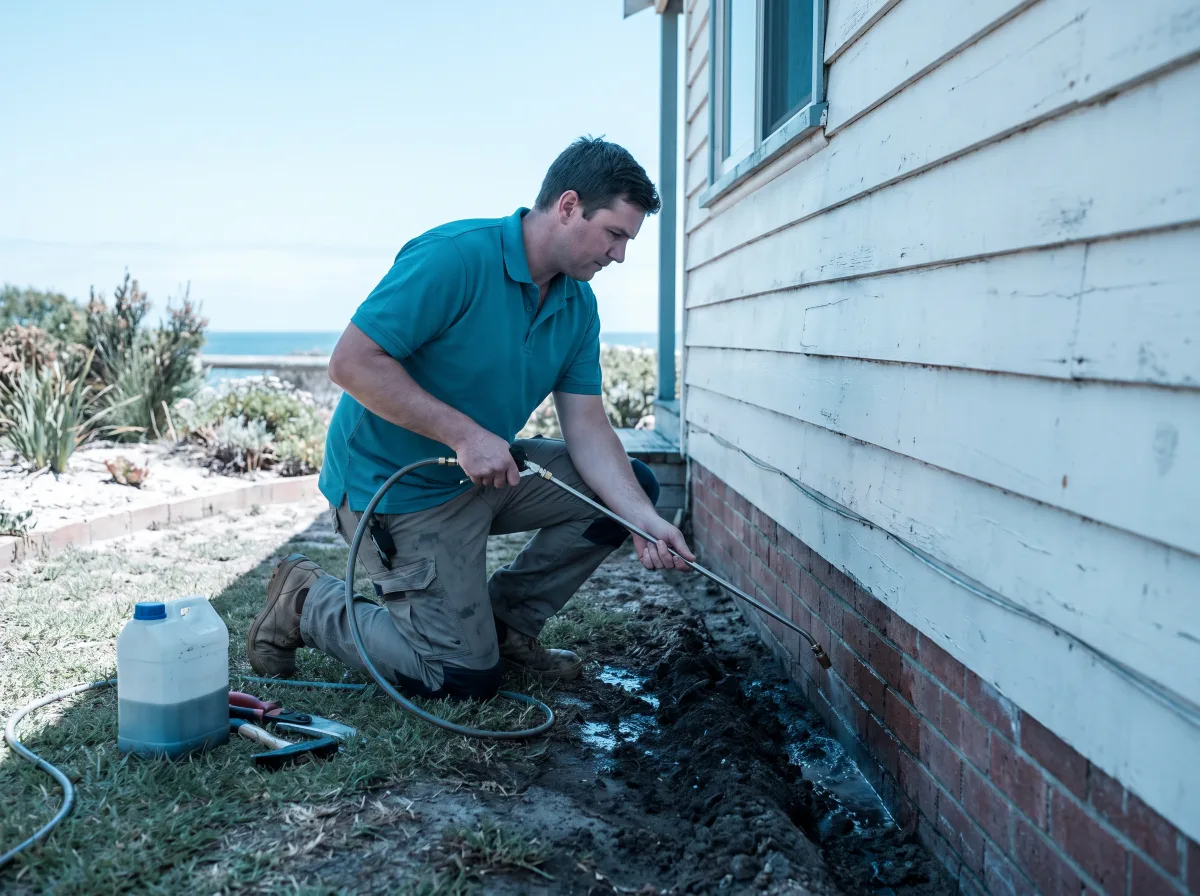
The technician creates a continuous band of treated soil around the perimeter of the building, and beneath the points where termites get in: the slab penetrations, the pier lines, the joins where paths and additions meet the house. In soil that means trenching along the footings; against concrete it means drilling and injecting so the treated zone runs unbroken under the slab edge too. A gap is a doorway, so continuity is the whole job.
Modern barriers use a non-repellent chemistry, and that's the part worth understanding. Termites can't detect it, so they don't avoid it. They move through the treated soil as usual, pick up the active ingredient, and carry it back into the colony through ordinary contact with nest-mates. The barrier does more than block the ones at your wall; it works back toward the nest that sent them.
What it asks of you: leave the treated zone alone. No new garden beds built up over it, no soil re-graded against the walls, no trenching for irrigation across it. Disturb the band and you open the doorway the barrier was laid to close. It also has a service life, so it wants periodic reapplication down the track, and your annual inspection still stands regardless.
The second approach
How baiting and monitoring works
Stations placed around the property and checked on a schedule. Slower to show its work, but it uses the colony's own behaviour against it, and it treads lightly on the site.
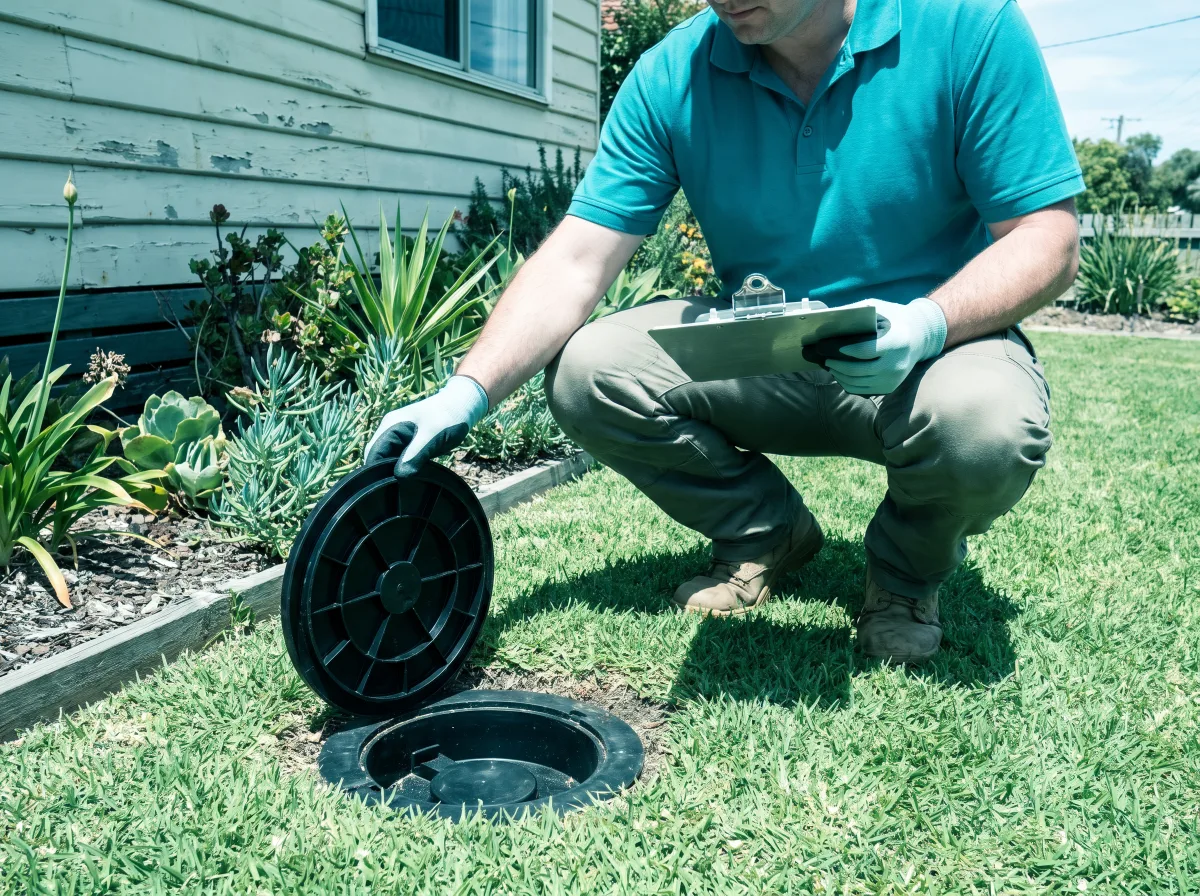
Stations go into the ground around the property, and where there's a known active lead, directly onto the workings above ground. Each holds a bait the termites take readily. The active ingredient is a slow-acting growth regulator, the kind of compound that interrupts the moulting termites depend on to live. It's slow on purpose: the foragers feed, return to the nest, and share the bait through the colony before it acts, so the effect reaches inward rather than just killing the few at the station.
That's why baiting is a relationship, not a single visit. The stations only do their job when they're actually checked: read on a schedule, topped up when activity shows, and watched until the colony is gone and stays gone. The pay-off is that it's contained. There's no soil saturation, minimal runoff, and it suits sites where a continuous barrier would be impractical or unwelcome.
What it asks of you: patience and access. The result develops over weeks to months, not on the day, and the stations need the technician back on the round to keep working. Leave the station lids clear and undisturbed between visits, and don't treat the surrounding soil in a way that drives termites off the stations.
Side by side
The two, on the same page
Set against each other on the things that actually separate them. Read it as a way to understand the trade-offs, not to pick a winner: the right column for your home is the one the findings point to.
| On this | Chemical soil barrier | Baiting and monitoring |
|---|---|---|
| How it works | A continuous treated zone in the soil that termites carry back to the colony as they pass through it. | Stations of growth-regulator bait that foraging termites carry back and spread through the colony. |
| Speed of protection | Fast. The treated zone is doing its job the moment it's completed. | Slower. The colony effect builds over weeks to months as foragers carry the bait home. |
| Where it suits | Homes where the full perimeter can be trenched or drilled and treated without gaps. | Sites where a continuous barrier isn't practical, or where eliminating the colony is the aim. |
| Site sensitivity | Needs full soil treatment, which can be unsuitable close to the lake, waterways, bores or sub-slab services. | Contained in stations, minimal runoff, well suited to waterfront and sensitive gardens. |
| What it asks of you | Leave the treated zone undisturbed: no new beds or re-graded soil over it. | Let the technician back on schedule and keep the stations clear between visits. |
| The ongoing rhythm | Treatment now, periodic reapplication over the barrier's service life, annual inspection alongside. | Ongoing by design: a regular monitoring and servicing round that doesn't stop when activity does. |
| The standard | AS 3660.2 for existing homes (AS 3660.1 covers new building work). | AS 3660.2 for existing homes. |
Neither column is the better one in the abstract. A block on the water might rule out full soil treatment on its own; a home with a clean, trenchable perimeter and active termites at the wall might call for the direct approach first. Same district, same standard, different answer, house by house.
The deciding factors
What the inspection actually decides
The comparison above tells you the trade-offs. The inspection tells you which trade-offs are yours. These are the findings that tip the choice one way or the other, all of which need eyes on the property to establish.
A termite inspection reads the property in a set order and writes down what it finds. When it comes to management, a handful of those findings do most of the deciding. None of them can be guessed from the kerb, which is exactly why the order is inspection first, quote second.
The report doesn't hand you a bill and a system. It hands you the true condition of the home and a recommendation with reasons attached, so the conversation about barrier or baiting is one you can actually follow. How to read a timber pest report walks the document through section by section.
Live termites in the timber often mean dealing with the activity first, before any longer-term system is settled on.
Whether the full boundary can be trenched or drilled without gaps decides if a continuous barrier is even on the table.
Subfloor timber, slab on ground, additions and paths against the walls all change where treatment has to reach.
Proximity to the lake, a waterway, a bore or sub-slab services can rule full soil treatment out and point to stations.
Baiting only works if the stations can be reached and read on a schedule, so the site has to support the rhythm.
Nothing here is a diagnosis, and nothing here is a price. We won't tell you which system your home needs from a web page, and we won't quote a barrier or a baiting program from the footpath, because an honest answer to either question depends on what the inspection turns up. The report comes first; the recommendation and the quote follow it in writing.
Not always one or the other
The choice isn't always a clean fork
Barrier and baiting are the two main approaches, but they aren't the only shapes the work takes, and they aren't mutually exclusive. A few of the in-between paths worth knowing about.
| Approach | What it is |
|---|---|
| Treat the active first, then decide | Where there's a live infestation, dealing with the immediate activity comes first, and the longer-term barrier-or-baiting decision is made once the pressure is understood. |
| Above-ground stations | A baiting station placed directly onto known workings, a mud lead or damaged timber, rather than in the ground. Faster to reach an active colony than in-ground stations alone. |
| Reticulation systems | A network of pipes laid in the soil around or under the slab, so termiticide can be injected or replenished through access points over time, without re-trenching. |
| Barrier plus monitoring | A treated zone for direct protection, with stations kept around it to catch any pressure early. Two layers rather than a single method. |
You don't need to arrive knowing which of these fits. They're here so the words in a quote make sense, and so you can ask why one was chosen over another. The reasoning should always trace back to a finding in the report.
Straight answers
Questions people ask when they're deciding
I've been quoted a barrier. Should I be asking about baiting instead?
Ask why that approach, not whether the other one is better. A sound quote can tell you what the inspection found and why the barrier suits your home over baiting, or the reverse. If the quote can't point back to findings, the question isn't barrier versus baiting; it's whether an inspection has actually been done yet.
Which one is cheaper?
They're priced differently rather than one being simply cheaper. A barrier tends to be a treatment cost now, then periodic reapplication over its service life. Baiting tends to be a higher upfront install, then an ongoing monitoring and servicing fee. Which works out better for you depends on your home and how long you'll hold it, and either way the real figure is quoted from the inspection, never from the footpath. We don't publish termite management prices for the same reason we don't diagnose from a photo: an honest number needs the findings under it.
We're right on the lake. Does that change things?
It can. Full soil treatment relies on saturating the ground, and close to the water, a bore or sensitive garden that isn't always suitable. Contained bait stations have minimal runoff, so on some waterfront blocks the findings point that way for good reason. It's a genuine factor here, but it's still the inspection that confirms it for your particular block, not the postcode.
Can I have both?
Often, yes. A common shape is to treat an active infestation first, then run a barrier or a monitoring program, and some homes carry a treated zone with stations around it as a second layer. It isn't always a clean either/or; the report will say what makes sense for your home.
Does a soil barrier last forever?
No. A treated zone has a service life and wants periodic reapplication to stay continuous, and it can be broken by re-graded soil, new garden beds or trenching across it. It also doesn't replace the annual inspection; it sits alongside it. Nothing in termite management is set-and-forget, which is the honest case for keeping the whole thing on a schedule.
The quote I got didn't mention an inspection. Is that normal?
It shouldn't be. A management quote is a recommendation about how to protect your home, and a recommendation needs a look under the house to stand on. If a quote names a system and a price without a completed inspection behind it, treat it as a starting point to question, not a finished answer. Booking the inspection is the step that makes every quote after it a real one.
Sources worth your time
- NSW EPA: pesticide and pest management licensing. Termite management is licensed work in NSW and carries its own endorsement on top of a base technician licence. This is the regulator that administers it.
- Standards Australia. The AS 3660 series governs termite management (AS 3660.1 for new building work, AS 3660.2 in and around existing structures).
- Australian Pest Control Association: termite control options. A plain overview of soil barriers, baiting and monitoring, and physical barriers as management approaches.
- CSIRO. Australia's long-running research base on subterranean termite species and behaviour, if you want the biology under the building advice.